How to train AI on your writing style
Custom instructions capture what you can describe about your writing. The patterns that make you distinctive are the ones you've never articulated.
Custom instructions and pasting examples capture the surface of your writing style. To make AI actually sound like you, you need a structured map of your patterns extracted from your real writing, not a paragraph of adjectives in a settings field.
Key takeaways:
- Pasting examples into ChatGPT captures surface patterns, then drifts within 10-15 messages.
- Custom instructions describe your voice from memory. Reading your own writing for patterns discovers what self-description misses.
- A structured voice guide with 50+ concrete patterns outperforms a settings field every time.
The prompt that almost works
There's a prompt on Reddit that goes something like this:
Read these three examples of my writing before you do anything else. Don't write anything yet. First tell me: my tone in three words, something I do consistently that most writers don't, words I never use, how my sentences run.
It works. The model reads your samples, identifies real patterns, and the next few outputs land closer to your voice. Then you start a new conversation and the patterns are gone.
Three samples also cap what the model can find. You get sentence length and word avoidance, but not argument structure or how your pacing shifts between a tweet and a blog post. After 10-15 messages the examples lose their grip on the model's attention, and the output drifts back to default.
Why custom instructions plateau
Search "how to make ChatGPT sound like me" and every guide gives the same advice: paste examples into custom instructions, add a line about your tone. Zapier, Copy.ai, Forte Labs all say the same thing.
These guides all stop at a paragraph of preferences in a settings field.
That's describing your voice from memory. You write down what you think you do: "direct," "uses short sentences," "avoids jargon." This captures what you can consciously articulate. That's a fraction of what makes your writing yours.
The rest is patterns you've never noticed. Which punctuation you avoid entirely, what constructions you reach for when making a concession. You've been doing these things for years without thinking about them.
Describing from memory and discovering by reading are two different processes. Custom instructions do the first.
And nothing you learn in a single session carries forward. You notice the model keeps using "ensure" when you'd say "make sure." You fix it.
Next session, "ensure" is back. The correction was never captured anywhere persistent.
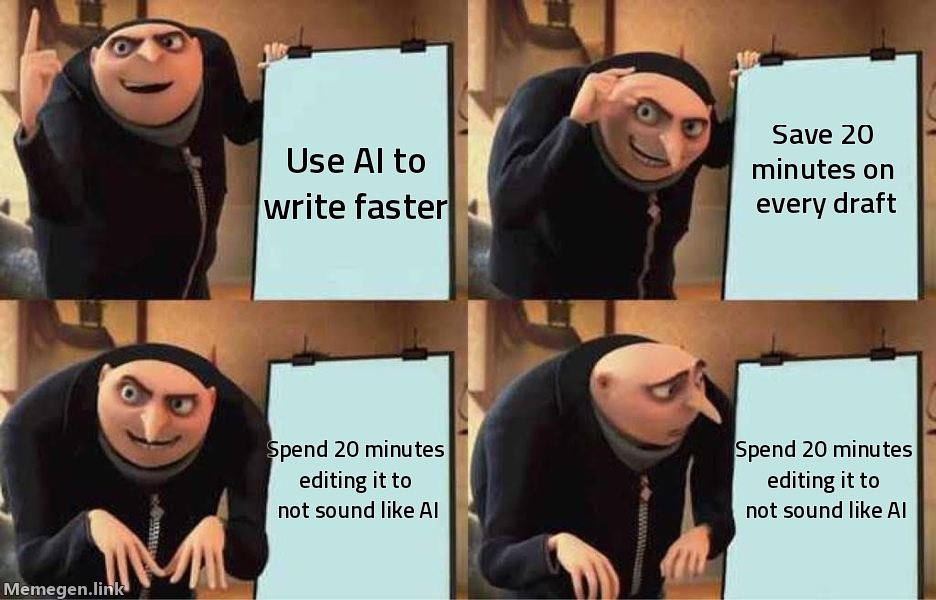
The promise of AI writing was speed. The reality is you generate a draft in seconds and spend the next ten minutes editing it back into your voice, restructuring arguments that don't build the way you'd build them. We broke down the math on that here.
How to extract your writing patterns
This takes a few hours and the output is a structured document you can use as a system prompt on any model.
1. Collect 5-10 samples per format you write.
Tweets, blog posts, emails, whatever you publish regularly. Mix recent work with older pieces so you're capturing stable patterns, not just last week's habits.
2. Read them side by side, looking for specifics.
Not "what's my tone" but concrete observations. Words you reach for repeatedly. Words you never use. How your sentences end and where your analogies come from.
Read at the sentence level first, then zoom out to paragraph structure and argument flow. The sentence-level patterns are what custom instructions miss most.
3. Write what you find, organized by category.
Word choices in one section, sentence patterns in another. Be specific. "I never use the word 'utilize'" is useful. "I write in a direct tone" is not.
Categories to work through: word preferences (use and avoid), sentence endings, punctuation habits, analogy domains, how you handle concessions, how you open and close pieces.
4. Separate what's stable from what shifts by format.
Your word choices hold across tweets and long-form, but your sentence pacing changes. Note which patterns are core to everything you write and which adapt by format.
Core patterns go into every prompt. Format-specific ones load only when you're writing that format.
5. Test and revise.
Paste the full document as a system prompt before a writing task. Generate something, then compare the output against your actual writing.
Where the output diverges, your guide is either missing a pattern or describing one too vaguely. Update and test again.
A 50-line document of concrete patterns outperforms a 5-line paragraph of adjectives every time.
What this catches and what it misses
Manual extraction catches a lot. Word avoidance and analogy clustering, sentence rhythm and how you open and close pieces.
What it misses is subtler. Some patterns only emerge across 30-50 samples: how your argument density shifts mid-post, or the constructions you use when bridging from evidence to conclusion. The structural patterns underneath need either a very patient reader or an automated voice extraction tool like Noren.
The other limit is maintenance. Your writing evolves, and a guide you built six months ago may not match how you write today. When your voice shifts, the guide needs updating.
FAQ
How do I train AI to write in my voice?
Collect 5-10 writing samples per format and read them side by side for concrete patterns. Organize what you find into a structured document and use it as a system prompt. The process takes a few hours, or minutes with an automated voice extraction tool like Noren.
What is a voice profile?
A structured document that maps your writing patterns: word choices and sentence-ending habits, analogy domains and argument structure. It separates core identity (what holds across everything you write) from format-specific context (what shifts between tweets and long-form). The output is a Markdown file you can read, edit, and use with any AI model.
Can AI learn my writing style from examples?
From a few examples pasted into a conversation, AI picks up surface patterns like word choices and sentence length. Deeper patterns need structured extraction across more samples and formats. In-context examples degrade after 10-15 messages as the model drifts back to its default voice.
How many writing samples does AI need to learn my voice?
Five per format is the minimum. Pattern depth scales with count: at 5 samples you catch word choices and basic rhythm, at 20-30 you start to see argument structure and analogy clustering.
Format variety matters as much as volume. Five tweets and five blog posts reveal more than ten of either.
What's the difference between tone and voice?
Tone is "professional" or "casual." Voice is the concrete patterns underneath: sentence-ending habits and punctuation avoidance, argument structure and where your analogies come from.
Tone can be described in a sentence. Voice requires reading your actual writing. AI tools capture tone reliably, but voice is what they miss.
Can I use this guide across different AI models?
Yes. A structured voice guide works as a system prompt on ChatGPT, Claude, Gemini, and local models through Ollama. The guide is a Markdown document, not a model-specific configuration. Switch providers and it comes with you.
How often should I update my voice guide?
Whenever your writing changes noticeably, or roughly every 3-6 months. Compare recent writing against the guide and update any sections where patterns have shifted. A stale guide produces output that sounds like an older version of you.
Related reading
Your voice, preserved
Extract your writing patterns. Generate text that sounds like you.