AI brand voice tools compared: who actually learns your voice?
Six tools claim to extract brand voice. Here's what each one actually captures, where it locks you in, and which makes sense for you.
Brand voice tools split into two camps: those that extract patterns automatically and those that require manual setup. The difference matters. One side learns your actual voice. The other learns what you can describe.
What matters in brand voice tools:
- Extraction depth: Does it extract only tone, or sentence rhythm, argument structure, and analogy domains?
- Portability: Can you use the profile on any model, or is it locked to one platform?
- Effort: Automatic (5 samples) vs. manual setup (hours of work)
- Price: From free (ChatGPT) to $59/month (Jasper enterprise)
The tools
Jasper (Brand Voice): Analyzes uploaded content and brand guides to extract tone, vocabulary, and messaging preferences. It then enforces those across Jasper's template library and team projects. Strength: automatic consistency for marketing copy. Weakness: locked to Jasper's platform. Pricing: $59–$99/month for marketing teams.
Copy.ai (Brand Voice Studio): Extracts tone, vocabulary, and sentence structure from 300+ words of samples. Built for agencies managing multiple client brands. Strength: can switch between distinct voices, affordable. Weakness: shallow extraction, platform lock-in. Pricing: $49–$100/month depending on features.
Writesonic (Brand Voice 2.0): Analyzes 100+ documents with vector-database methods. Captures tone, vocabulary, narrative style, and sentence structure. Strength: deeper pattern recognition than Jasper or Copy.ai. Weakness: locked to Writesonic's output. Pricing: $7.50–$45/month.
Shortwave (Ghostwriter): Fine-tunes a model on your actual email history. Learns your sentence structure, sign-offs, common phrases, and response patterns directly from what you've written. Email only. Strength: learns from real behavior, not manual input. Weakness: doesn't transfer to tweets or blog posts. Pricing: Free with premium features available.
ChatGPT (Custom instructions): You write rules about your tone, style, and preferences manually. Zero extraction. Strength: free (or $20/month for Plus), works with any ChatGPT model. Weakness: limited to what you can articulate. Misses patterns you don't consciously know. Pricing: Free or $20/month for Plus.
Noren: Automated extraction from 5–10 writing samples across multiple formats. Output is a portable Markdown file you own. Works with any LLM. Strength: extracts deeper patterns than any alternative. Weakness: requires samples across formats for full depth. Pricing: Free with BYOK, or $7/month founding tier.
Quick comparison
| Tool | Extraction depth | Portability | Price |
|---|---|---|---|
| Jasper | Tone + vocabulary | Locked to Jasper | $59–$99/month |
| Copy.ai | Tone + vocabulary | Locked to Copy.ai | $49–$100/month |
| Writesonic | Tone + vocabulary + narrative | Locked to Writesonic | $7.50–$45/month |
| Shortwave | Tone + vocabulary + structure | Email-only | Free |
| ChatGPT | What you describe | Works with ChatGPT | Free or $20/month |
| Noren | Sentence rhythm, argument structure, analogy domains, rhetorical moves | Works with any LLM | Free (BYOK) or $7/month |
What extraction depth looks like
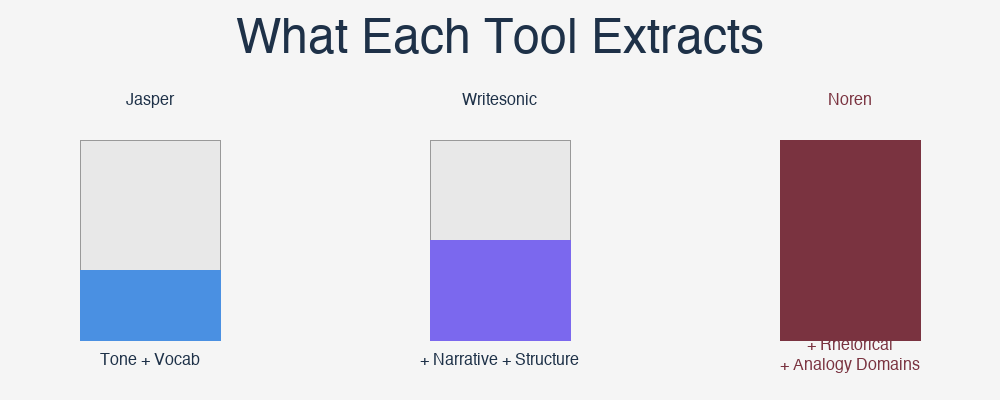
Jasper & Copy.ai: Tone and vocabulary. Surface layer. Word choice and formality level.
Writesonic: Adds narrative style and sentence structure. One level deeper. Captures how you organize paragraphs and build arguments.
Shortwave: Adds response patterns and sign-off structure. Email-specific but goes deeper into behavioral habits.
ChatGPT: Limited to what you can describe. Misses everything below conscious awareness.
Noren: Sentence rhythm, argument architecture, analogy domains, rhetorical moves. These are the patterns that make your writing unmistakably yours. The structural layer, not the surface.
Profile portability
Five tools lock your voice inside their ecosystem. Stop paying or switch models, and your profile stays behind.
A Noren voice profile is a Markdown file you own. Load it into Claude, GPT, Gemini, or any LLM. Share it with a colleague. Commit it to git. Use it anywhere.
Every other tool requires vendor lock-in. Noren doesn't.
When each tool is the right choice
Jasper makes sense for marketing teams staying in Jasper's workflow. It's a content production tool with brand voice as a feature.
Copy.ai makes sense for agencies managing many client brands. Train a voice for each without leaving the platform or paying per-brand fees.
Writesonic makes sense if you have 100+ documents and want automatic extraction. Feed your past writing in, get a profile back, without manual setup.
Shortwave makes sense for email-heavy teams. It fine-tunes on your actual email history. Email-only, though, so the voice won't transfer to blog posts or tweets.
ChatGPT custom instructions make sense if you want basic tone consistency and can describe your preferences manually.
Noren makes sense if voice fidelity is the goal. Writers, ghostwriters, founders, and newsletter authors need output that actually sounds like them, not just "on brand." See how it compares in output or how the extraction works.
Try Noren free or see pricing for plan details.
More comparisons in this cluster
- Noren vs ChatGPT custom instructions: real output comparison
- Why Jasper's Brand Voice isn't actually your voice
- Noren vs Jasper vs Copy.ai: three-way deep dive
FAQ
What is the best AI tool for brand voice?
It depends on what "brand voice" means for your use case. For marketing teams wanting consistent tone across copy, Jasper or Copy.ai handle that well. For writers and founders who need output that actually sounds like them, including structural habits, analogy patterns, and argument style, those tools don't extract deeply enough. Noren is the only tool that extracts rhetorical structure, not just tone.
Does Jasper Brand Voice actually learn your voice?
It learns your brand's tone and vocabulary preferences, which is useful for marketing copy. It doesn't extract argument architecture, analogy domains, or the sentence-level habits that make a writer's voice distinctive. The gap shows most clearly in long-form content, where structure matters as much as word choice.
What's the difference between a voice profile and custom instructions?
Custom instructions are what you manually describe about your writing: tone, word preferences, format rules. A voice profile is extracted from your actual writing by analyzing patterns across samples. Custom instructions are bounded by what you can consciously articulate. A voice profile captures patterns you've never noticed.
Can I use a voice profile on multiple AI models?
Noren's profiles are Markdown files that work on any model: Claude, GPT, Gemini, Ollama, or any model that accepts a system prompt. Other tools lock the voice to their platform. See pricing for plan details.
How many writing samples does a voice profile need?
5–10 samples per format you write in: tweets, blog posts, emails. More formats produce a richer profile. The extraction maps what's stable across everything you write and what shifts by format.
Your pattern is waiting.
Extract your writing patterns. Generate text that sounds like you.