ChatGPT's favorite words (and why they're ruining your content)
You can spot AI writing by its vocabulary. These are the words and phrases that give it away, why they cluster in AI output, and what to use instead.
You know AI writing when you read it, even without a disclosure. The grammar is clean, the structure holds up, but something in the vocabulary sets off a quiet alarm.
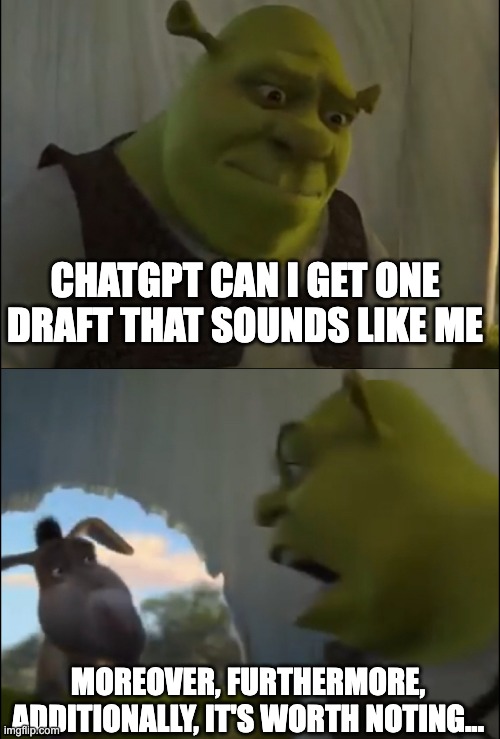
Certain words appear in AI output so consistently that they function as signatures. Not because any single word is a giveaway on its own, but because AI clusters them at a density no human would. The list below covers the most common ones, why they show up, and what to do about them.
Key takeaways:
- AI writing draws from a default vocabulary shaped by formal training data, not individual voice.
- The training pipeline rewards polished, neutral language at every stage, which is why the same words keep showing up.
- Swapping individual words doesn't fix the problem. The model has no map of your patterns to override its defaults.
Single words that give it away
Delve
No one says "delve" in conversation, and no one types "let me delve into that" in a text message. Yet it appears in ChatGPT output so often that it's been tracked as a specific marker of AI-generated text. A 2024 study in Scientometrics found a statistically significant spike in "delve" across PubMed abstracts published after widespread LLM adoption.
You don't need the word. "Look into" or "dig into" if you need a replacement, or just cut the sentence. The paragraph works without it.
Crucial / pivotal / imperative
"Data quality is crucial for AI success."
"Crucial" adds nothing here. The sentence is asserting importance without showing it. When AI calls everything crucial, the word stops doing any work. Try:
"Bad training data produces bad outputs, no matter how good the model is."
Now the reader sees why it matters instead of being told that it does.
Leverage (as a verb)
"Leverage your strengths." "Leverage this insight." The word means "use," and "use" is almost always clearer. AI reaches for "leverage" because it saturates business writing, where it picked up a false sense of strategic weight. In practice, it adds syllables and removes directness.
Multifaceted / comprehensive / nuanced
"This is a multifaceted issue" tells the reader nothing about the issue. Describe the facets. "Comprehensive" appears before every plan, guide, and overview regardless of whether the thing it describes is actually complete. And if something is truly nuanced, show the nuance.
These three adjectives all mean "complicated" and are deployed as if complexity is automatically a virtue.
Testament
"It's a testament to their dedication and hard work."
No one reaches for "testament" in casual writing. What this sentence actually means:
"They put in the work, and it shows."
Simpler, warmer, and it doesn't sound like a press release.
Realm
"In the realm of AI writing." "In the realm of marketing." The word is doing nothing. Cut it. "In AI writing." "In marketing." Done.
Foster
"Foster connections." "Foster growth." "Foster community." AI picked this up from mission statements and org-speak, where it sounds warm and deliberate. In most sentences, "build" or "grow" is cleaner.
Navigate (metaphorically)
"Helping teams navigate the challenges of remote work."
Unless someone is literally steering a boat, try:
"Helping teams handle the hard parts of remote work."
"Navigate" gets used metaphorically so often in AI output that it has become a tell on its own. "Handle," "work through," or just describing the specific action is almost always better.
Vibrant
Every city is vibrant. Every community is vibrant. Every creative scene is vibrant. The word has been drained of meaning through sheer overuse. Say what's actually happening: "active," "busy," "growing," or describe the scene specifically enough that the reader can picture it.
Underscore
"This underscores the importance of..." is a formal way of saying "this shows" or "this confirms." Human writers use it occasionally. AI uses it constantly because it sounds appropriately analytical.
Replace with "shows," "confirms," or restructure to make the point directly instead of announcing it.
Phrases that announce the AI
"In today's fast-paced world..."
The most recognized AI opener. It has appeared in so many AI-generated posts that it functions as a signature. Whatever sentence follows it would be stronger standing on its own.
"It's worth noting that..."
A hedge. The phrase signals something the model wants to include but isn't sure how to position. If it's worth noting, note it. If you need to announce that it's worth noting, it probably isn't.
"As we navigate [topic]..."
Combines the metaphorical "navigate" tell with a collective "we" that no specific writer would actually use. It's framing language that sounds thoughtful but commits to nothing.
"Whether you're a [X] or a [Y]..."
"Whether you're a seasoned marketer or just getting started..." AI uses this construction to gesture at a broad audience without committing to a specific reader. It reads as inclusive. It lands as vague. If you know who you're writing for, write for them.
"It is imperative that..."
A formal way to say "you need to." The formality doesn't add urgency, it adds distance. Direct is almost always better: "You need to," or just the imperative form: "Do this before you ship."
Why these words cluster in AI output
The pattern isn't random, it's a product of how these models are built.
The training data sets the vocabulary. Models like GPT are trained on text from the web, but Wikipedia, academic papers, and news articles pass the quality filters that curate the training data, so formal English gets disproportionate weight. Words like "delve," "crucial," and "landscape" appear frequently in those sources, and the model assigns them high probability whenever it generates informative or explanatory text.
Supervised fine-tuning narrows the style. Before the model is released, human contractors write example responses that teach it how to answer questions. Those examples are written in a polished, helpful style because that's what the task instructions reward, and the model learns that style as its default.
Reinforcement learning locks in the pattern. After fine-tuning, human reviewers rate the model's outputs on helpfulness. They aren't scoring style directly, but polished, formal-sounding text sounds better to reviewers. It gets higher ratings.
The model learns this implicit preference and amplifies it, converging on a narrow stylistic band that sounds professional but belongs to no one.
Real writers have preferences, words they reach for and words they avoid, rhythms that feel natural and ones that don't. AI has none of that. It draws from defaults that favor formal competence whether the prompt calls for a LinkedIn post, a newsletter, or a text message.
What this costs your content
When your content uses these words, it doesn't just sound like AI. It sounds like everyone else who uses AI.
Your LinkedIn post reads like the one before it in someone's feed. Your newsletter reads like the last three AI-written newsletters they opened. Your voice, the thing that makes readers recognize your work before they see the byline, disappears into the default.
The fix isn't a word swap list
Replacing "delve" with "explore" removes one tell. The underlying problem stays: the model has no map of your writing patterns, so it falls back on the defaults it learned during training.
When you catch these words in a draft, don't just swap in a synonym. Ask what you'd actually say. That question, repeated enough times, is the fix.
But it's slow, and it resets every time you open a new chat.
The structural fix is giving the model something to override its defaults with: a style guide extracted from your actual writing, specific enough that it reaches for your patterns instead of its own. We wrote a full walkthrough of how to build one. Noren automates the voice extraction if you'd rather not do it by hand.
The words on this page are tells. The default voice is what produces them. Replace the default, and the tells go away on their own.
Your voice, preserved
Extract your writing patterns. Generate text that sounds like you.