How to audit your own writing voice in 15 minutes
You have a writing voice. You probably can't describe it. This exercise changes that and shows you exactly what AI is missing when it writes for you.
Ask a writer to describe their voice and you'll get adjectives: direct, conversational, a bit irreverent. Ask a reader who has spent real time with that writer's work and you'll get something more specific: the way they always open with a scene before making the argument, the analogies drawn from construction rather than sports, the habit of putting the sharpest sentence at the start of a paragraph rather than the end.
The writer doesn't know what the reader knows. The patterns are there, but they're invisible from inside the writing.
This exercise takes 15 minutes and closes that gap. By the end, you'll have a rough map of your own voice: the kind of map that tells AI what to actually replicate, not just what tone to aim for.
What you need
Five to seven pieces of your writing, from the same general format. Five blog posts, or five newsletters, or five LinkedIn posts. Don't mix formats for this exercise. Pick the format you write in most and pull recent examples.
Open them side by side, or print them out. You're going to read across them, not through them.
The 8 checks
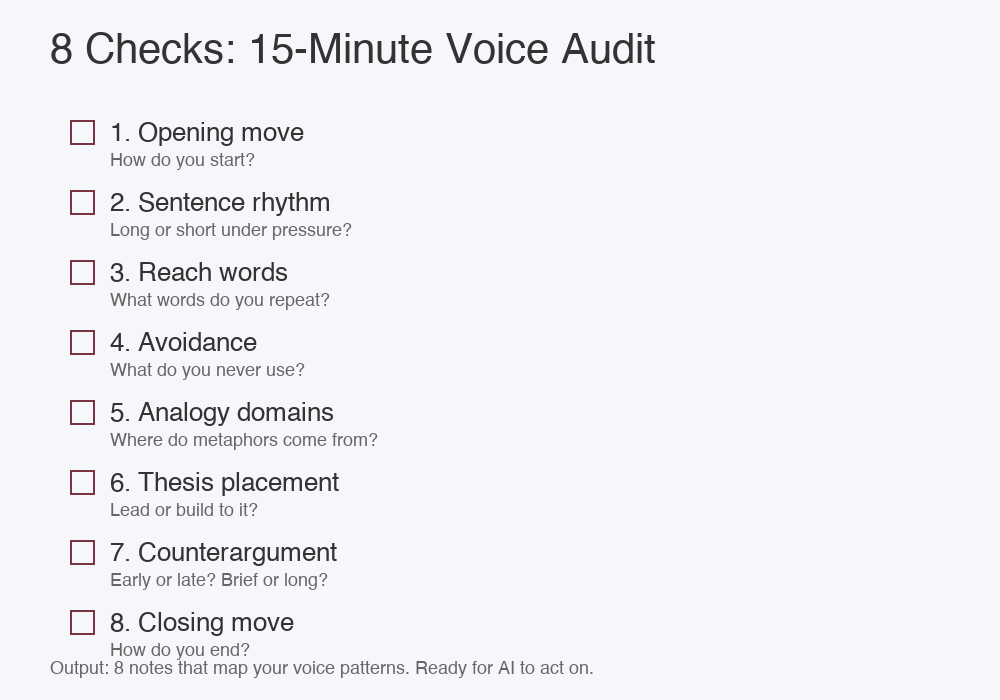
1. Your opening move
Read only the first sentence or first paragraph of each piece. Don't read further.
What pattern do you see? Some writers always open with a question they spend the piece answering. Some open with a scene that expands into an argument. Some lead with the thesis immediately. Some open with a counterintuitive claim followed by evidence. Most writers have one default they return to across everything they write without realizing it.
Write down your opening pattern in one sentence: "I usually open by ___."
Example filled-in: "I usually open by naming a specific problem or moment before zooming out to the larger context."
2. Your sentence length under pressure
Find the section in each piece where you're making your most important argument. Read just those paragraphs.
Do your sentences get shorter or longer at the climax? Some writers go short and emphatic when they care most - punchy, flat declarations that land hard. Others build momentum with longer sentences, accumulating clauses until the point lands at the end of a long run.
Note which direction you go when you're pushing hardest.
Example filled-in: "I shift to shorter sentences: short, declarative, three to five words each."
3. Your reach words
Read through all five pieces looking for words that appear in more than two of them. Not common words like "the" or "this," but words with some character: specific, concrete, actual, particular, precisely, genuinely, quietly. Words that feel like you.
Write down the three to five words that appear across multiple pieces. These are your reach words - the vocabulary you return to when you're thinking clearly.
Example filled-in: "actual, specific, surface-level, invisible, pattern"
4. Your avoidance pattern
Look for any word in one piece that you'd never write in another. Something that sounds off, that you might have used once and never repeated. Then look for entire categories of language that are absent: sports analogies, corporate vocabulary, hedging phrases, exclamation points.
Write down one or two categories of language you consistently avoid. "I never use" is a more powerful voice signal than you'd expect.
Example filled-in: "I never use exclamation points or corporate jargon like 'leverage,' 'synergy,' or 'moving forward.'"
5. Your analogy domains
Find every comparison or analogy across all five pieces. Don't just look for "like" and "as": look for any moment where you explain one thing by referencing another.
What domains do the references come from? Construction, engineering, cooking, biology, sports, film, parenting, geography? Most writers draw from a tight set of two or three territories across everything they write. Those territories are part of the texture that readers associate with your voice.
Example filled-in: "construction and architecture (blueprints, scaffolding, foundations), film (editing, pacing, framing), writing itself"
6. How you handle your thesis
In each piece, find where the main point first appears. Is it in the first paragraph, or does it arrive later after the argument has been built up?
Some writers state the thesis immediately and spend the piece defending it. Others build the case first and let the thesis land late. The approach is consistent, and readers feel it as part of how you think, not just how you write.
Example filled-in: "I state the thesis in paragraph two, after a brief setup scene. Then I spend the rest of the piece expanding on it with examples."
7. How you handle the counterargument
Find the moment in each piece where you acknowledge that someone might disagree with you, or where you address a complication in your argument.
Where does it appear? Early, to show you've considered the objection before making the case? Late, after you've already made it? Briefly, in a single clause, or at length? Some writers never concede anything directly. The pattern is stable and specific to you.
Example filled-in: "I concede early and briefly. Usually a single clause: 'Sure, some writers work differently, but...' Then I move on."
8. Your closing move
Read only the last paragraph of each piece.
What shape do they take? A callback to the opening? A short declarative that lands the thesis one more time? An invitation, a question, a forward-looking observation? Some writers always close with a single sentence. Others always close with a paragraph that tapers. The ending signature is as distinct as the opening one, and almost no writer notices theirs until they look across multiple pieces at once.
Example filled-in: "I always close with a single sentence. It restates the core claim plainly, usually with a forward-looking angle."
What you should have now
Eight notes. One for each check. Here's what it looks like when filled in:
- I usually open by naming a specific problem or moment before zooming out to the larger context.
- I shift to shorter sentences: short, declarative, three to five words each.
- actual, specific, surface-level, invisible, pattern
- I never use exclamation points or corporate jargon.
- construction and architecture, film, writing itself
- I state the thesis in paragraph two, after a brief setup scene.
- I concede early and briefly. Usually a single clause: "Sure, but..."
- I always close with a single sentence that restates the core claim plainly.
Together they sketch the pattern-level profile of your writing voice: not "I write conversationally" but "I open with a scene, go short under pressure, reach for 'specific' and 'actual,' draw analogies from architecture and film, state the thesis in paragraph two, concede early and briefly, and close with a single declarative."
That's the kind of description an AI can actually act on. Not a tone setting, but a map of specific habits. Read it alongside the seven patterns AI typically misses and you'll see exactly where the gap lives between a generic AI output and one that sounds like you.
What this exercise can't catch
You'll find the patterns you can see. The exercise is limited by the same thing custom instructions are: your own powers of observation on your own work.
Some of the most distinctive patterns in your writing are the ones you're least able to notice:
Vocabulary clustering. Words that travel together across pieces. You might notice that you use "specific" and "actual" a lot. You'll probably miss that they tend to appear in clusters of 2-3 per piece, and that they cluster specifically with certain other words.
Micro-constructions. The small sentence shapes you reach for in specific rhetorical situations. "Sure, but..." is obvious. The exact positioning of your subordinate clauses, or the cadence you fall into when making concessions, is harder to catch in 15 minutes.
Rhythm shifts. How your sentence structure changes subtly across different types of arguments. These shifts happen at the sentence level and require looking across many more samples than 15 minutes allows.
What structured extraction does is run this kind of analysis at scale: across more samples, across more dimensions, catching what self-analysis misses. The output is a Markdown profile you can read, compare to your own notes, and edit.
Run this exercise first. It sharpens what the automated extraction finds, and it makes the profile easier to evaluate when you see it. You'll know which findings are real because you'll have already noticed them yourself.
Extract your voice automatically or learn more about the extraction process.
More on voice analysis
- 7 writing patterns AI always misses
- How to train AI on your writing style (deep dive)
- Custom instructions won't save your voice
FAQ
Is 15 minutes really enough to find all my patterns?
No. It's enough to find the obvious ones: the patterns you're somewhat aware of but haven't consciously named. Deeper patterns like vocabulary clustering or rhythm shifts at the sentence level require analyzing more samples and looking more carefully. Use this exercise to bootstrap your awareness, then use structured extraction to find what you missed.
What if I notice contradictions in my patterns?
That's real. You might open with a scene sometimes and with a thesis other times. You might go short under pressure in some pieces and long in others. Note the variation. The profile should capture both the dominant pattern and the exceptions.
Should I use the same format for all five pieces?
Yes, for this exercise. Mixing tweets with blog posts will show you format differences, but those will muddy the core voice analysis. Pick one format you write in regularly and pull five recent examples.
What if I can't find a clear pattern?
Not all writers have a strong pattern in every dimension. Some writers have wildly varied sentence lengths. Some don't have a consistent analogy domain. That's useful information. If you don't have a pattern, that's what the profile should reflect.
How does this exercise compare to running Noren's extraction?
This exercise captures what you can see about yourself. Noren's extraction captures what your writing actually does across larger samples, including patterns you've never consciously noticed. Do both: the manual audit makes the automated profile easier to evaluate and trust.
Can I use this to brief a ghostwriter or collaborator?
Absolutely. These eight notes become an actual voice brief. Hand it to someone who's writing in your voice and it gives them concrete habits to emulate, not just tone guidance.
What if some of my patterns feel embarrassing or undesirable?
Those patterns are part of your voice. You can dislike them and still have them be authentically you. If you genuinely want to change how you write, that's separate from documenting how you actually write. The profile is descriptive, not prescriptive.
Your pattern is waiting.
Extract your writing patterns. Generate text that sounds like you.