AI ghostwriting for founders: sound like yourself at scale
77% of consumers are more likely to buy from founders with a strong social presence. AI makes every founder sound the same. That's the gap.
You read a founder's tweet on Tuesday, an investor update on Wednesday, a hiring pitch on Friday. Same person, three completely different voices.
That's what AI does, and founders pay the price.
77% of consumers are more likely to buy from founders with a strong social presence. 44% of a company's market value is attributed to the CEO's reputation. Personal profiles outperform company pages by 5-8x on engagement. The writing is the brand, and the consistency is the moat.
Key takeaways:
- A founder's personal brand directly drives company growth, hiring, and fundraising. The writing can't be generic.
- AI ghostwriting tools either cover one platform or flatten your voice into the same template everyone else uses.
- The structural fix is a voice profile that carries your patterns across tweets, investor updates, hiring pitches, and blog posts.
Why the ghostwriting market exists
The global ghostwriting market is $4.3 billion and growing at 7% annually. LinkedIn ghostwriting retainers run $1,000-5,000 per month per client. That market exists because every AI tool makes the same promise and fails the same way.
Every tool claims it writes like you. The output reads like everyone else. The same convergence that flattens all AI writing hits founder content harder because the audience is paying attention. Your investors read your updates closely, your team reads your announcements for tone, and your followers subscribed to your voice, not your topics.
LinkedIn's algorithm increasingly penalizes generic AI content. The platform has shifted toward rewarding posts with unique expertise over recycled advice. Generic AI output is becoming a measurable liability on the one platform where founder voice matters most.
The real problem isn't volume
Founders have things to say, but the problem is structural. They write across more formats than any other role: tweets, LinkedIn posts, investor updates, hiring pitches, blog posts, newsletters. Each format has different conventions and structural expectations.
AI treats each one as a blank slate. A tweet from Tuesday doesn't sound like the investor update from Thursday, which doesn't sound like the blog post from the following week. The model handles each request as a new task with no memory of who the writer is.
Professional ghostwriters solve this over months, learning the constructions their client reaches for, the argument moves that feel natural, how they characterize their company. That calibration costs thousands per month. It doesn't scale.
Custom instructions can't carry the structural patterns that make your writing recognizable across formats. What founders need is extraction, not instruction.
What extraction actually does
Extract your voice from 15-20 pieces of your actual writing across the formats you use. The system separates what's core to your voice from what shifts by format.
The core identity layer captures what's stable: word choices that travel through tweets and long-form alike, the analogy domains you draw from when explaining your work, the things you never say. The format-specific layer captures what adapts: how dense your tweets are versus how your blog posts breathe.
Load both layers before generating. The model no longer guesses who you are. It writes the pitch you would write, at the density your tweets use, with the analogies you'd reach for.
Editing shrinks from a rewrite to a read-through.
Cross-format consistency: Your voice carries whether you're writing a tweet or a board memo. The density and pacing shift, but the voice is unmistakably yours.
Speed without overhead: The time savings math applies more to founders than anyone. CEOs spend 24% of their work time on electronic communication. When every AI draft needs a rewrite to sound like you, the productivity gain disappears, and voice extraction eliminates that rewriting step.
What currently exists in this space
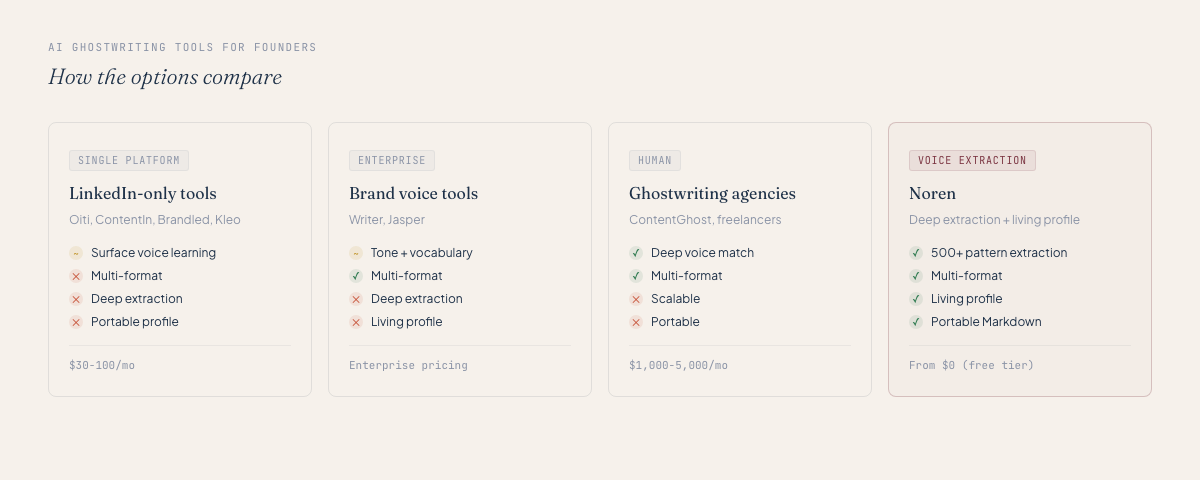
The current tools fall into three categories, and none solve the structural problem.
LinkedIn-only tools (Oiti, ContentIn, Brandled) learn from your past posts on a single platform. They can't generate investor updates or hiring pitches. The voice learning is surface-level, and if you switch platforms, the learning doesn't travel.
Enterprise brand voice (Writer, Jasper) extract tone and vocabulary for corporate brands, not individual founders. The profiles are static, and corrections don't train the system.
Human agencies (ContentGhost at $4,500/month) produce great results but don't scale. One ghostwriter, one client, months of calibration.
Noren's AI voice extraction is built for the gap these three categories leave open: deep extraction from your actual writing, generation across every format you use, and a profile you own and can take anywhere.
FAQ
What is AI ghostwriting for founders?
AI ghostwriting uses your writing patterns to generate content that sounds like you across every format: tweets, LinkedIn posts, investor updates, hiring pitches, and blog posts. The goal is voice consistency at scale, not just content production.
Why does founder personal branding matter?
77% of consumers are more likely to buy from founders with a strong social presence. 44% of company market value is attributed to CEO reputation. Personal profiles outperform company pages by 5-8x on engagement. The writing is the brand.
Can AI match a founder's writing voice?
With custom instructions alone, AI covers about 10% of your actual patterns. With structured voice extraction from 15-20 writing samples, coverage rises to about 90%. The difference is whether the tool describes your voice or extracts it from evidence.
How is this different from hiring a ghostwriter?
Human ghostwriters produce excellent results but cost $1,000-5,000/month and require months of calibration. A voice profile achieves similar consistency across formats, scales to any volume, and costs a fraction. The profile is also portable: switch tools or models and your voice comes with you.
Your pattern is waiting.
Extract your writing patterns. Generate text that sounds like you.