How to use AI for your newsletter without losing your voice
Newsletter readers subscribe to a person, not a topic. The writers who keep them do one thing differently with AI.
Newsletter readers didn't subscribe to your topic. There are a hundred sources covering the same thing. They subscribed to you: how you think, what you notice, what you find worth saying.
When that changes, they leave. Not all at once. Gradually, as the writing stops sounding like you.
The solution: extract your voice patterns first, then generate. One voice profile, any model, every issue. This is how newsletter writers maintain authenticity at scale.
Why style prompts fail
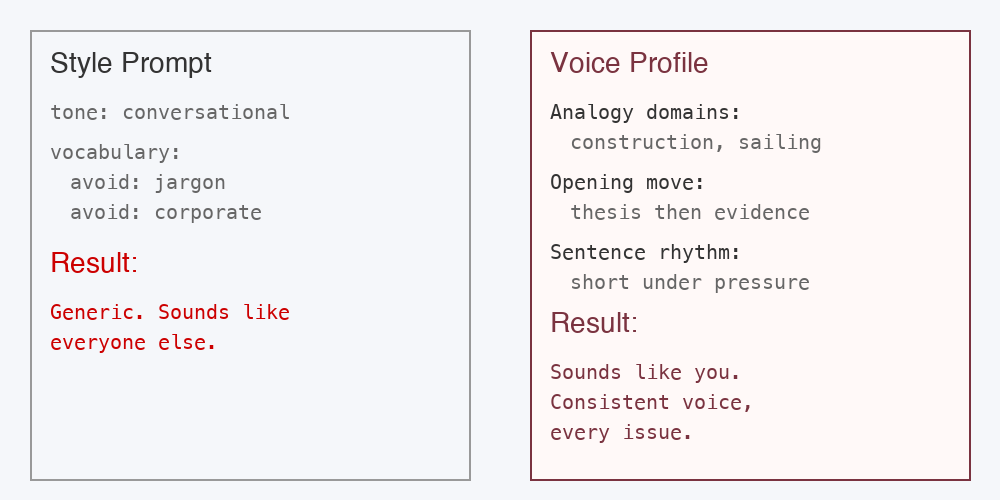
Most writers try to fix this with a style prompt: "write in a conversational tone." The model complies. It reads clean. But something's gone.
Your newsletter usually reaches for construction metaphors. This one pulls generic startup framing. The way you build from one idea to the next is different. The moment where you shift from explaining to concluding has shifted.
A style prompt is tone. Your voice is something deeper. Your voice is the specific territories your metaphors come from. How you construct arguments. The rhythms that carry you from problem to resolution. These patterns are stable across every piece you've published, but you've never named them. A style prompt can't capture what you've never articulated.
Extract first, then generate
The fix happens upstream: pull your patterns from published work before you ask the model to write.
Extract from 10–15 issues across your archive. Not your best work. Issues from the last year so the model sees what's consistent. This produces a voice profile: your analogy domains, argument structures, sentence rhythms, what you avoid.
A voice profile is readable. It's a Markdown file you can open and see exactly what patterns the system found. Every pattern comes with examples from your actual writing.
Then the workflow changes. You arrive with your notes: the point you're making, examples, the angle. Load the profile and your notes together.
The model generates a draft that holds your structural habits, not just your tone but the actual shape of how you think.
The editing pass becomes different. You're checking for accuracy and moments where the model invented beyond the profile, not rewriting to sound like yourself.
What actually stays yours
Your ideas. Your angle. The specific examples only you could draw. The profile shapes how you express these, not what they are.
This is the distinction: one automation replaces thinking, the other carries it. The profile handles voice. Your readers subscribed because of how you think. That doesn't change. This is AI voice consistency done right: extracting patterns, not replacing thought.
Noren's voice consistency engine is built for this: extract once, generate in your voice across every issue. See how to extract your voice or start for free.
More on writing with AI
- The time savings are a lie: why AI editing still takes hours
- Why AI writing sounds the same: the convergence problem
- Custom instructions won't save your voice: what extraction does instead
FAQ
Why do newsletter readers care about voice more than other audiences?
They chose you specifically. They didn't find you through search or algorithm. They subscribed to a person. When your writing changes, they lose the reason they showed up.
Can I use a style prompt to keep my voice?
Partially. A style prompt maintains tone. But voice is deeper: the territories your analogies come from, how you structure arguments, the specific moment where you shift from making your case to closing it. These patterns are invisible to self-description. A prompt can't capture what you've never articulated.
How much of my old work do I need to extract from?
10–15 issues across different topics. Include work you're not proud of. The extraction finds what's stable across the variety, not what's exceptional. Span at least a year so patterns surface clearly.
What happens to my ideas if I use a voice profile?
Nothing changes. Your ideas, angle, examples, specific observations—all of it stays yours. The profile shapes expression, not content. This is voice automation, not content automation.
Is a voice profile the same as a style guide?
No. A style guide is what you write about your writing. A voice profile is extracted from your actual writing. The extraction finds patterns you've never consciously noticed and couldn't describe.
Your pattern is waiting.
Extract your writing patterns. Generate text that sounds like you.